Additional information
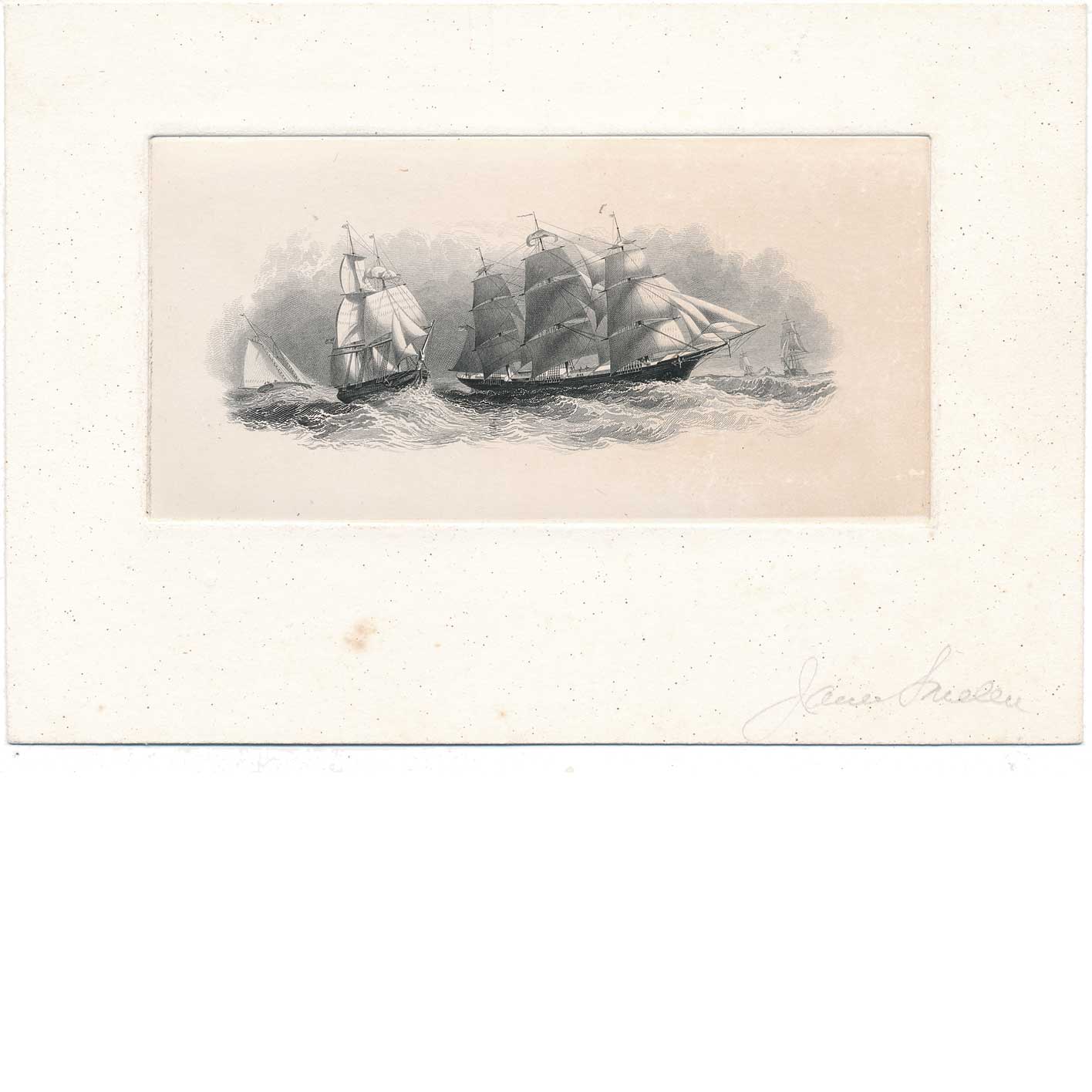
| Engraver | James Smillie |
|---|---|
| Condition | VF, small foxing spot |
| Year | 1870s |
| Paper | india die sunk on card |
| Size | 4.25" x 2"; overall 7" x 5" |

$75.00
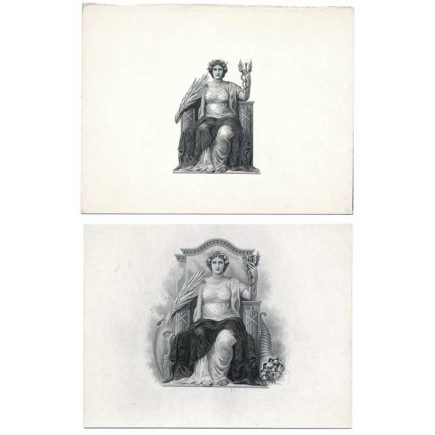
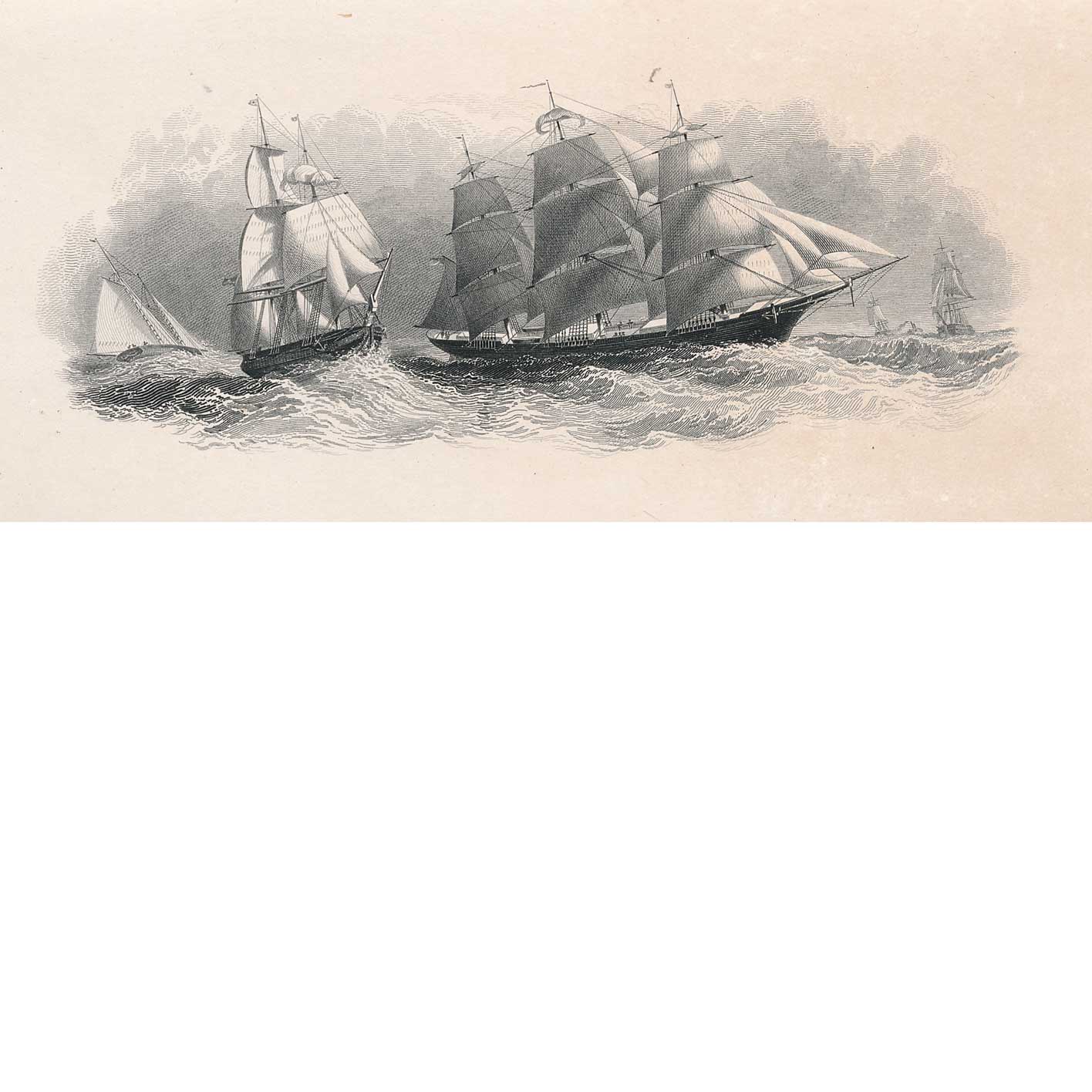
This engraving is a fine example of a die proof vignette produced by the American Bank Note Company (ABNCo), expertly executed by Scottish-American master engraver James Smillie (1807–1885). Known for his meticulous detail in maritime and historical subjects, Smillie often collaborated with his son, James David Smillie, who also worked for the ABNCo. This specific work, typical of the firm’s security printing in the mid-to-late 19th century, depicts a dynamic scene of clipper ships and smaller sailing vessels navigating choppy seas, intended for use on banknotes, stock certificates, or other high-security financial documents. The sharp, fine-line technique characteristic of Smillie’s steel engravings provided both an aesthetic elegance and a critical anti-counterfeiting measure, as such intricate details were nearly impossible for contemporary forgers to replicate.
The American Bank Note Co. traced its beginning back to Philadelphia and Robert Scott, who started a bank note business in that year. Scott was also engraving for the United States Mint. Finally he relinquished his interest in bank notes and the firm was taken over by John Draper, who had been his assistant. At some time during the long period to 1858, each of the founding firms in some manner, or form had been connected with Scott or Draper, thus establishing the date of beginning as 1795. The name “American Bank Note Company” was used by Jocelyn, Draper, Welsh & Company, in addition to its regular name, since 1854, with the thought that it could be later used by a bank note engraving and printing institution. In 1858 the leading bank note firms-seven in number-united to form an association, which was incorporated under the title of the American Bank Note Company, Association. The founding firms were Rawdon, Wright, Hatch & Edson, New York, Cincinnati, New Orleans, and Montreal, with Isaac Carey of the New England Bank Note Company, Boston, and George Matthews, Montreal; Toppan, Carpenter & Company, New York, Philadelphia, Cincinnati, and Boston; Danforth, Perkins & Company, New York, Philadelphia, Cincinnati, and Boston; Bald, Cousland & Company, New York and Philadelphia; Jocelyn, Draper, Welsh & Company, New York, with Draper, Welsh & Company, Philadelphia; Wellstood, Hay & Whiting, New York and Chicago, and John E. Gavit, Albany. It was agreed among the firms to associate and thus survive the depressions that were occurring, especially the one of 1857. The articles of agreement were signed April 29, 1858, and an official announcement of the Association was issued on May 1, expressing its purpose as:
“For the purpose of placing the bank note currency of the country upon a basis of greater security, with the same features of stability and perpetuity that pertain to Banking Institutions.”
In the spring of 1859, Edmonds, Jones & Smillie, a comparatively new firm, joined the Association. The Association continued business under the agreement until 1879 when the National and Continental Bank Note Companies joined, and the name was then changed to the American Bank Note Company, Consolidation.
| Engraver | James Smillie |
|---|---|
| Condition | VF, small foxing spot |
| Year | 1870s |
| Paper | india die sunk on card |
| Size | 4.25" x 2"; overall 7" x 5" |