Additional information
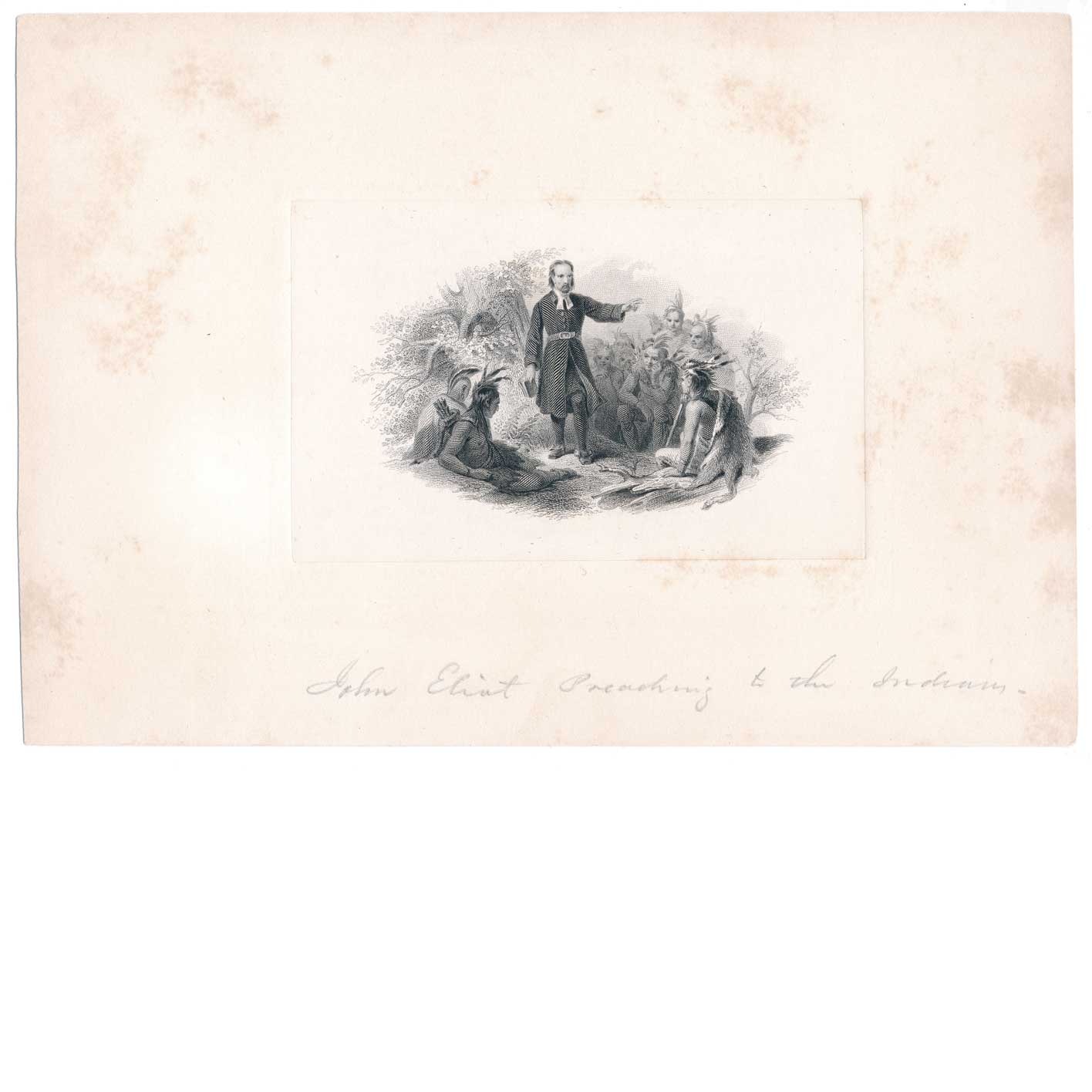
| Artist | F.O.C. Darley |
|---|---|
| Condition | F, some foxing |
| Year | 1860s |
| Paper | india die sunk on card |
| Size | 3.25" x 2"; overall 7.25" x 5" |

$60.00
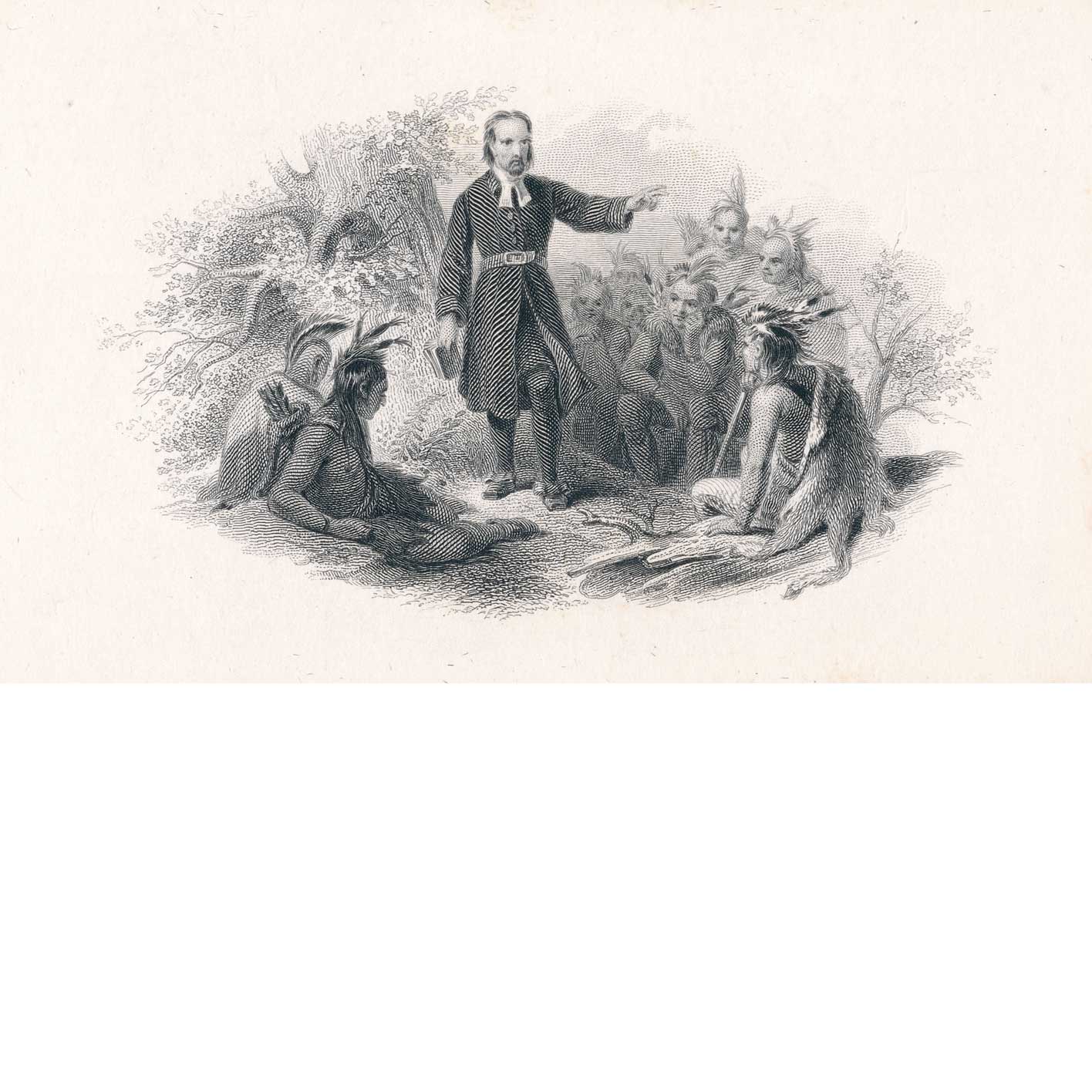
This vignette die proof on India paper mounted on card depicts the Puritan missionary John Eliot (1604–1690) preaching to a group of Massachusetts Indians. Known as the “Apostle to the Indians,” Eliot immigrated to New England in 1631 and began his missionary work in 1646, eventually translating the entire Bible into the Algonquian language. The scene typically illustrates Eliot standing as a central figure, gesturing solemnly to his audience as he explains Christian tenets, such as the Ten Commandments. This specific engraving style was popular for historical illustrations and was even featured on financial documents, such as proof checks from the Boston National Bank. The composition reflects a common 19th-century artistic theme that aimed to portray Eliot’s efforts to establish “praying towns” and convert indigenous tribes to Christianity.
Born in Philadelphia, Pennsylvania, Felix Octavius Carr Darley began drawing in his youth. He moved to New York City, New York in 1848 and in 1850 he was invited to illustrate Washington Irving’s works ‘The Legend of Sleepy Hollow’ and ‘Rip Van Winkle’. He continued to illustrate works by Washington Irving but added James Fenimore Cooper, Nathaniel Hawthorne, Longfellow, James Whitcomb Riley, and Charles Dickens, to his client list. He also designed bank notes and bonds for the U.S. government. His work helped popularize icons such as the Pilgrim, the Pioneer, the Minuteman and the Yankee Peddler. He became one of the best-known illustrators of his time, so great was the demand for Darley’s work that new books were promoted as illustrated by Darley. The Philadelphia Inquirer noted that Darley “dominated American illustration for nearly a half-century.”
Note: this is an ORIGINAL india proof; not a reproduction or contemporary print. Your satisfaction is guaranteed.
| Artist | F.O.C. Darley |
|---|---|
| Condition | F, some foxing |
| Year | 1860s |
| Paper | india die sunk on card |
| Size | 3.25" x 2"; overall 7.25" x 5" |