Additional information
| Engraver | James Smillie |
|---|---|
| Condition | VF, internal tear |
| Year | 1864 |
| Paper | india |
| Size | 3" x 2" |
| Artist | F.O.C. Darley |

$35.00
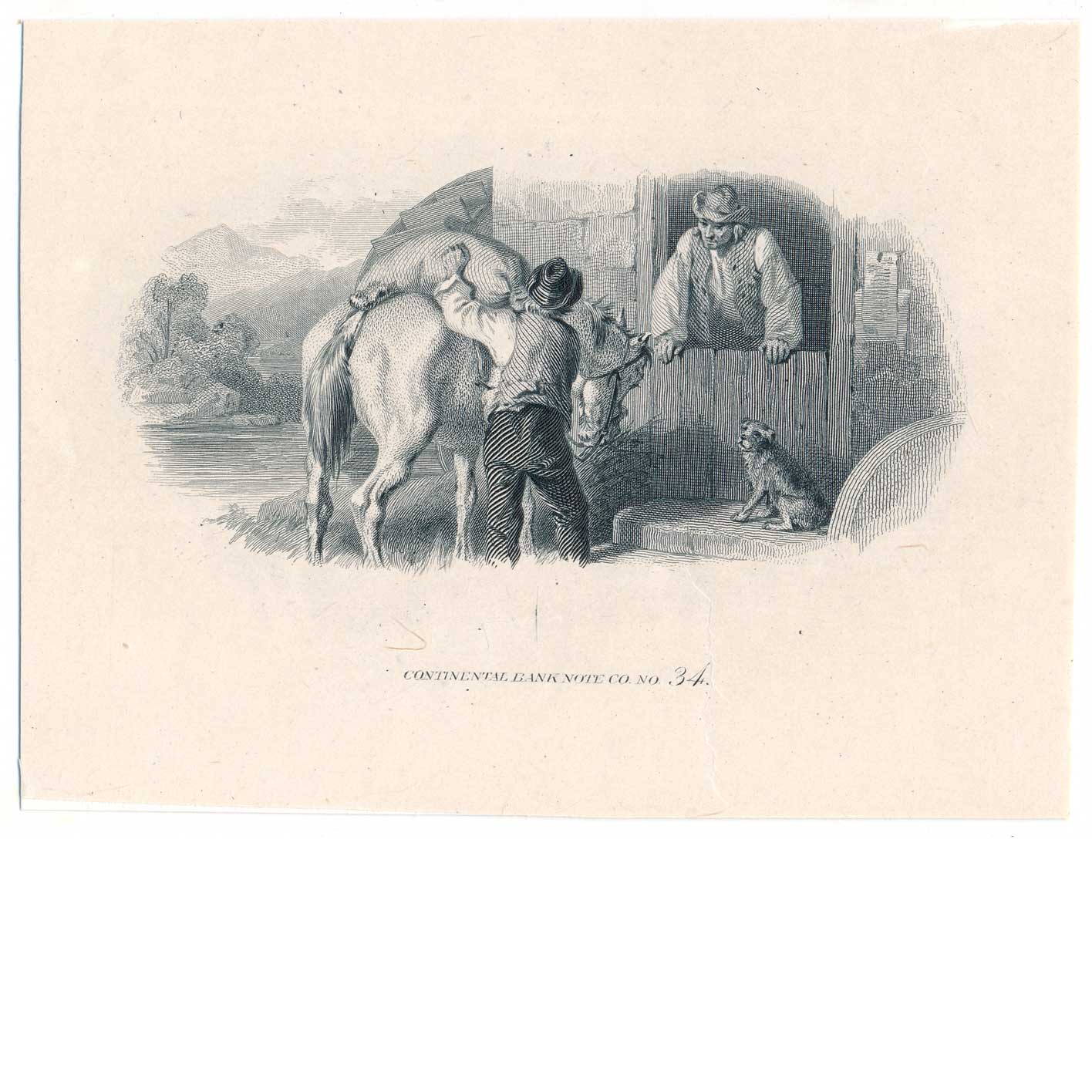
This die proof, titled “The Mill Door” (also known as “The Horseman’s Welcome”), was engraved by James David Smillie and printed by the Continental Bank Note Company. The vignette features a tranquil rural scene where a rider has dismounted his horse at the Dutch door of a stone building, presumably a mill or tavern, to engage in conversation with a man leaning out over the lower half of the door. A small dog sits attentively on the doorstep, completing the domestic, narrative-driven composition typical of 19th-century American genre art. The fine-line steel engraving showcases Smillie’s technical mastery in rendering diverse textures—from the muscularity of the horse and the heavy folds of the men’s clothing to the rugged stonework of the building—originally intended for use as a security vignette on high-quality financial documents or banknotes.
Born in Philadelphia, Pennsylvania, Felix Octavius Carr Darley began drawing in his youth. He moved to New York City, New York in 1848 and in 1850 he was invited to illustrate Washington Irving’s works ‘The Legend of Sleepy Hollow’ and ‘Rip Van Winkle’. He continued to illustrate works by Washington Irving but added James Fenimore Cooper, Nathaniel Hawthorne, Longfellow, James Whitcomb Riley, and Charles Dickens, to his client list. He also designed bank notes and bonds for the U.S. government. His work helped popularize icons such as the Pilgrim, the Pioneer, the Minuteman and the Yankee Peddler. He became one of the best-known illustrators of his time, so great was the demand for Darley’s work that new books were promoted as illustrated by Darley. The Philadelphia Inquirer noted that Darley “dominated American illustration for nearly a half-century.”
James Smillie was born in Edinburgh, Scotland, on 23 November 1807. James’ father started his own silversmith shop in Quebec and employed James, who set to work developing his engraving skills. He soon moved from engraving names in rings, etc, to more elaborate engravings for visiting cards. He received a number of orders for engraving various scenes.
In 1830 he and his brother James David moved to the United States in search of better job opportunities. James’ career flourished and he became known for his quality engravings, which made the major banknote printing firms sit up and pay attention. In 1861, the National Bank Note Co hired him as Master Engraver. James Smillie retired in 1874 but remained active as an engraver, even doing the odd job for the ABNC. He passed away on 5 December 1885.
| Engraver | James Smillie |
|---|---|
| Condition | VF, internal tear |
| Year | 1864 |
| Paper | india |
| Size | 3" x 2" |
| Artist | F.O.C. Darley |